Friday, January 4, 2008

Night - Essay

Moonisah Ali
Mrs. Bosch
English 10 Honors
8 January 2008
Lying Morally

It is in the human nature to lie. All humans lie. Lies extend from small ’white lies’ to lies that omit the truth. Reasons for lying varies from situation to situation. People often lie to protect themselves or to protect others. Humans that value morality often feel right about lying to protect others, whether it is out of love or pity. Often enough lying to protect someone is considered moral. A person is showing compassion by trying to save a person from horrible news when lying for the protection of others. In the novel Night, written by Elie Wiesel, in his writings Wiesel describes the living conditions of the concentration camps and the grisly violence that had taken place night after night before his very eyes. Wiesel explains how families were torn apart and separated from one another and were sent to different camps. Wiesel’s family being one of them. Wiesel talks about how one morning an alleged cousin happens to run into Wiesel and his father and claims that his wife was Wiesel’s mother’s aunt and that she had written his mother many letters to stay in touch. The man, Stein, asks Wiesel if he knows the whereabouts of his wife and his little boys. Wiesel (assuming they had all died) had lied to Stein and told him that they were all fine. Although Stein had later figured out about his family’s death, it was still morally correct of Wiesel to lie to Stein.
Stein was a ‘wrinkled, wizened’ old man. Wiesel and his father could not recall whether or not if Stein was their relative or not. Stein had presented himself as being delusional through his attempts at trying to convince Wiesel and his father that they had been related. Wiesel, knew that his father would not remember since his, “father was always up to his neck in affairs of the Jewish community, and much less well versed in family matters” (40). His father was, “elsewhere, lost in his thoughts” (40). Wiesel had taken pity upon the poor man and lied. He had told Stein that, “Reizel is very well. The children too…” (41). Wiesel’s actions are justified because he had felt for the elderly man and had lied out of empathy. Looking at the old man Wiesel knew it would have killed him to have the slightest idea that his children and wife were dead. Looking at Stein must have made Wiesel think of his father (who at the time was not doing very well himself, health wise), and if his father were Stein, what would his father do if he knew that his wife and children had died? He had taken that into consideration through his empathy for the man. Wiesel knew that Stein would not have been able to go on if he had heard the news. Also, Wiesel must have felt that if Stein knew he had relatives around then he [Stein] would have some sense of comfort. Wiesel watched as Stein, “…wept with joy” (41). This was all after he had heard the good news (or the fabricated version of it anyway). Stein’s hopeful and pitiable face had made it so much harder for Wiesel to tell him the truth, and much easier to lie to his face.
To be moral is to be ethical and humane, to do what one perceives is just. Although Wiesel had lied to Stein about his family, it was still a morally correct decision to make. Stein had found out later about the ‘real news’ about his family’s existence, by lying to him about his family Wiesel had given Stein a little more amount of time to want to live and still have a reason to live. He had given Stein the will to live and be hopeful in life, something that the concentration camps had taken away from every man and woman. The concentration camps had taken everything away from the Jews, including their self-respect and will to live, and by Wiesel lying to Stein about his family all he was doing was just restoring what the concentration camps had destroyed -- a man’s will to live. The concentration camps were demoralizing these humans. Making them feel as if they were lower than dogs. They were taking away the peoples faith and instilling terror and killing their innocence. They were murdering innocent children and wives and fathers. Once a family had been separated people often did assume the worst because the worst was often the truth. Yet, Stein was just reaching out for something, anything that would keep him optimistic. Finding Wiesel and his father was a light of hope that shined within the barracks that had kept all of Stein’s pains and worries. As a result of Wiesel lying to Stein, he had conquered all of Stein’s pains and worries. Just knowing that his family was okay had brought faith back into his life. Wiesel had taken a moral approach by lying. After all, morals are based on being ethical to others and their situations. Knowing that his wife and kids were living had made him want to live, after all they were his life. A small lie had changed Stein’s will to live and given him more to hope for in his life -- even if it did just last a short while.
People lie for all sorts of reasons. Some are selfish ones, others are selfless ones. Some lies destroy, others protect. The lies that protect are often caused by morality. Wiesel’s value for morality had shown when he had lied to Stein about his family. Wiesel had lied to protect Stein from further pain and suffering (the pain and suffering in the concentration camps was enough, there was no need for more). To be able to want to help someone whether it is out of pity or love, even if one has to lie to protect, it shows that they value the person’s well being and their life. As Wiesel did for Stein. Even though Stein had found the truth out later, Wiesel had given him a small moment in time, a small moment in the concentration camp to feel as if there was still a chance to be happy again, that there was still a chance to live again, that there was still a chance breathe again. Doesn’t every human want to feel that way, even if for just a moment?

Wednesday, December 26, 2007

Night - Questions

1. Elie Wiesel's hometown was Sighet, Romania.


2. Cabala is considered to be many of the teachings of the Torah. It is the study of the inner secrets of the Torah.

3. Eliezer wants to learn the truths of this world. These truths are the truth about God and his existence or non-existence on this earth.


4. Moshe the Beadle is significant to the novel because he is the very frist one to be sent away and witness the evils of the cremetory and concentration camps. Luckily his escape made it possible for him to be able to warn the other people, unfortunately they did not believe him. Moshe the Beadle tells Elie that "There are a thousand and one gates leading into the orchard of of mystical truth. Every human being has his own gate. We must never make the mistake of wanting to enter the orchard by any other gate than our own..." Moshe is persistent about his adomination to Elie because he believed if Elie were able to believe him than others might also. Plus the fact that Moshe did not talk to many, and had opened up to Elie and took him under his wing to teach him the Cabala had made Moshe more worried about Elie. So he felt the need to caution Elie for himself and his life.

5. Moshe the Beadle is poor and allegedly insane. Therefore, the people of Sighet were less likely to believe him. If Moshe were a higher staure, such as Elie's father then maybe they would, but he wasn't, so they didn't. Also, probably because the Jews were afraid to believe him.

6. Madame Schachter is the woman on the train that kept screaming about the crematories and the fires. Warning people. She is very much like Moshe because their cries were left unheard and ignored. Poeple had assumed them to be crazy.

7. The passage on page 32 talks about how Wiesel’ s faith was snatched from him. How God no longer existed in his world and how alone he was without a God. How fear was so instilled into his mind that after that point in the camp he knew that he had entered a world without a God, without faith without humane morals

8. In this passage Elie is referring to his first Night watching the childeren be burned. Elie's belief in God is slowly slipping and later he slowly gives up on believing that God is around.

9. In the exposition of the Night Elie gradually changes his perception of God. When his world collapses he soon finds himself as a non believer.

"Never shall I forget that nocturnal silence which deprived me, for all eternity, of the desires to live. Never shall I forget those moments which murdered my God and my soul and turned my dreams to dust. Never shall I forget these things, even if I am condemned to live as long as God himself. Never"(32).

10. The symbolism of night is ongoing in the novel. When day becomes night the conidtions become more worse. People suffer more during the night than the do during the day.

11. Night is a slim book because Wiesel probably couldn't handle adding more. He had already suffered so much and by writing this book he was reliving all of those moments. Maybe he wasn't ready to relive all of them.

12. Night is more of a tragedy. It has all the elements of tragedy. The pain, the suffering and the death. Also the denial.

Wednesday, December 12, 2007

Night - Journal Entries

saPages: 1-10
Entry: 1
12 December 2007

Quote: "There are a thousand and one gates leading into the orchard of mystical truth...We must never make the mistake of wanting to enter the orchard by any other gate but our own."

Moshe the Beadle tells this to Elie as Elie complains about not having a mentor to teach him about the cabbala. This quote is very interesting. It seems that Moshe the Beadle is saying that there is one path for everyone. That we should not cross the ones that are not meant for us, for we may not be capable of handling whatever comes are way.

After Moshe escapes he tells his stories to the others, but they do not believe him. I find it highly disgusting of what was happening throughout that time and what Moshe had witnessed. Babies were used as target practice. This just shows that humans are as defenseless as chimps yet vicious as gorillas. What is it that is so appealing about the weak? Why must people have this need to feel stronger than others? Without the weak the strong are absolutely lost. The vilence that was described in these few pages was haunting, I can only imagine what it was like for Moshe the Beadle and others who have witnessed it.

I feel terrible for all of the people who were so easily manipulated. The German officers knew exactly how to handle the situation. They acted as protecter's, or observers. Then they gave them a place. The "ghetto", which they innocently thought was a place where they could be closer with no outsiders. They made them feel comfortable and waited until Passover was done so they could start their killing. They were evil bloodsuckers. The people didn't even see it coming, and the reason was because who would have thought such horrible ideas could be contrived by the human mind! It's disgusting. Furthermore! It seems as if they are losing their faith in God. It is a horrible thing when someone can strip you of your faith.

Pages: 11-21
Entry 2
13 December 2007

I find it strange that human beings can cause other human beings to suffer. I'm not quite sure what is inside of us that enjoys it. Enjoys inflicting pain. Enjoys inflicting agony. Enjoys inflicting heart ache. Perhaps it's the power. We enjoy oppressing. We enjoy feeling superior to the weak.

Wiesel tells how people were forced to leave their possessions behind them because they [possessions] were of value. By leaving them behind would exeplify how these people were not of value. How they were worthless and meant nothing to the world. That is what the Germans wanted to instill in these innocent peoples minds.

"My father wept. It was the first time I had seen my father weep" (16).
Obviously, this was a man that did not show his pain. They had caused so much pain into him that he could no longer hold it in and he wept infront of his son, wife and daughter. They had broken his father. To do that to a human benig, to make them cry, not even, to make them weep, is something only a volatile creature could do.

14 December 2007
Entry 3
Pages 22-32

People were going mad. For example Madame Shacter who obviously went crazy and didn't know how to handle being separated from her loved ones. People were fearing for their lives. It's insane how other human beings can be such a threat. The other passangers just wanted her to shut up. Perhaps they didn't want to hear her because they were afraid she spoke the truth. Being ignorant was better than knowing I suppose.

15 December 2007
Entry 4
Pages 32-42

The Jews are being made to run these drills. They have no communication to the outside world except for what the Germans allow them to see. It's so interesting how they morphed their words to make the Jews feel comfortable in the concentration camps. It's so horrible how they manipulate the people's minds. Eventually, slowly each person begins to get angry with the other. Such as Wiesel with his father.

16 December 2007
Entry 5
Pages 43-53

They were given number stamps. And were only known as that number. That is terrible. To do that, they are showing that they were no longer living, breathing human beings, but they weren't even good enough to be given a name. They were all just worthless drones, floating in a sea of numbers. How horrible.

17 December 2007
Entry 6
Pages 54-64

Towards the end of this section of the book, it seems there are a few people that are losing their faith in God, and others, such as Wiesel, who blame or question God. These people have damaged the Jewish people so much that they have taken away their [Jews] faith. They have caused so much mental havoc in their minds that they are now questioning their own faith -- what they have known for years, and worshipped for years. Horrible.

18 December 2007
Entry 7
Pages 65-75

Elie Wiesel and the rest of the Jews have suffered so much dehumanization. It's disgusting. The Germans have rotted their brains and they can't even function well enough to know wether or not to believe in God.

19 December 2007
Entry 8
Pages 76-86

Elie had witnessed so much agony. His own, his father's and the countless number of stranger's. I admire his willingness to want to stay alive. Although, I do not understand why he still wanted to. Instead of taking the easy way out and dieing as quick as possible, he chose to stay alive and suffer day after day, a slow and painful death. The death of his faith, his soul. Elie was being torn apart peice by peice. Was he afraid of death so much that he wanted to live in pain? Was it because of the loss of faith in God he suffered, that he has no idea now what was waiting for him on the other side that he would rather live through hell.

20 December 2007
Entry 9
Pages 87-97

Elie talks about and 'audience'. He is referring to the people who watched them and threw bread at them. These 'spectators' would just watch. This was the most disgusting thing of all. People had found their misery, their torture, as entertainment.

21 December 2007
Entry 10
Pages 98-109

Living in the concentration camp had sucked the life out of Elie. Emptiness had consumed his emotions. He could no longer feel. Witnessing his father die slowly everyday had some how killed Eli on the inside. In the expostion of the novel I could tell that Elie had respect and love for his father, but being in the concentration camps had destroyed all of that. It really truly sucks to have those feelings taken away from a person. It's like being amputated from a part of yourself. A part of yourself you used to be so familiar with and then being thrown into unknown abiss filled with unusual emotions. Emotions you never thought you could never experience. Emotions you never thought existed. The camps ate away at the compassion that once filled Elie's heart. Neing so empty must make him feel so alone. So empty. So lost.

Monday, October 15, 2007

The Bell Jar

15 October 2007
Entry 1
Ch.1 Pages 1-13

The protagonist seems very interested in detail. She seems to be unhappy with herself even though she has accomplished so much. It's as if there is some sort of empty feeling she is having, like there is something missing and she cannot seem to pin point exactly what it is.
'He was the type of fellow I can't stand. I'm five feet ten in stockings, and when I'm with little men I stoop over a bit and slouch my hips...and I feel gawky and morbid..."(9) It seems as if she doesn't want to change for anyone, even if it is just a minor change. I know it's hard for me to change just to please anyone, so I can understand her displeasure in changing to suit others needs. She is quite an interesting character...

Entry 2
Ch.1
Quote: ' I felt very still and very empty, the way the eye of a tornado must feel, moving dully along in the middle of the surrounding hullabaloo.'

Hmm the protagonist feels like there is no connection with her and the outside world. That she is alone and no one feels the way she does and that no one understands.


16 October 2007
Entry 3
Ch.2 Page 15-19

Protagonist seems to like detail in everything. She went to this man's house and seemed to be interested in the detail of it. I think . . . Well anywho, the protagonist has very much emotional pain. She talks about how laying in a hot tub of water eases away everything and, 'cures' her from everything. It's as if everything is a problem, New York, the night before with Doreen, she needs an escape and to feel cleansed. And that is what she does. Also she talks about staing connected, it seems most of her interactions are over the phone maybe?

Entry 4
Page 22-23

Doreen seems to be Miss Greenwoods favourite person, otherwise she would not have put up with her. Esther Greenwood does not want others to portray her as a 'Doreen', Esther doesn't want to be known as a Marilyn Monroe, i.e. a whore. She would rather have people see her as a Betsy, a good wife. I do not think Esther knows exactly who she wants to be, because she talks about how somewhere deep down in her heart she is a Betsy, and on her outer core she is a Doreen. She is struggling between these two personalities.

17 October 2007
Entry 5
Ch.3 Page 24-26

Esther mentions how she loves to eat food, and that it doesn't matter what it is she'll eat it, especially when it's expensive, when it's expensive she'll buy a chain of it. Esther doesn't come from a big rich family, and she seems to resent others who do and don't appreciate it, but Esther seems like she loves the money. As if there's an endless amount of it. On top of the whole eating thing, Esther seems to eat a while lot of food. Is there a void in Esther that only food seems to fill? Odd.

Entry 6
Page 27

Esther comments on how she doesn't want to get married. She never really mentions why, just that she doesn't, becuase I assumed that she had wanted to be like Betsy, someone who was like a 'Susey homemaker' type. Obviously she seems to be ashamed of being like Doreen, and she is afraid of what others may think of her. But she doesn't want to be tied down to a man either.

18 October 2007
Entry 7
Quote: 'She looked terrible, but very wise.' Page 39

So what I am thinking here is that Esther is saying that when a woman happens to not look so attractive that she is most likely intelligiant. Jay Cee does not seem like the nicest person to Esther but apparaenlty she is unnatractive and unattractive poeple are smart.

Entry 8
Page 49

Esther and Doreen seem to be very close. Doreen's loyalty to Esther shows as she comes up ans surprises Esther as she has food poisoning.

19 October 2007
Entry 9
Page 51

Esther seems as if she unusal people and names interst her. Esther is a very unusual person. She has this resentment for Buddy. A terrible resentment. Buddy has done something very terrible, it's obviuos. Why else would she randommly think about him?

Entry 10
Pages 53-58

Esther must have had some sort of attachment to Buddy. Was he her first sexual encounter?
First love? First something?! Is this why she cannot seem to let the memories of him go?

20 Octover 2007
Entry 11
Ch. 6 Page 66-67

Esther had just watched a woman giving birth, and afterwards she still wanted kids? She's crazy. Esther watched it I am guessing for Buddy's sake because she didn't want him to think that she couldn't handle it. Otherwise she would feel that she was not up to his expectaions.

Entry 12
Page 73

Esther is just as much of a liar and a hypocrite as she accuses others of being! She lies to just about most people and makes up stories herself. She thinks Buddy being a hypocrite justifies her actions of being a hypocrite.

21 October 2007
Entry 13
Ch. 7 Page 76

Esther is feeling inadequate and to make it worse she is bringing herself down by pointing out all of the things she cannot do. She is honest with herself but not everyone else.

Entry 14
Ch. 7 Page 83

Quote: 'I could catch sight of some flawless man off in the distance, but as soon as he moved closer I immediatley saw he wouldn't so at all.'

This reminds me of when I was younger and went to a museum. I am not sure what statue it was but, from a distance this statue was beautiful. Perect and completley flawless. As I edged closer to view this god-like statue, I could see the cracks. The little imperfections that weren't noticeable until I came closer. What Esther is saying is that, when you distance yourself off from a person that there is no chance of you disliking them, that wat you won't have to notice how not right they are. But once you get emotionally and physically closer, you begin to nocitce everything that is wrong with them. Esther cannot find herself getting emotionally closer to someone because she fears she'll dislike them.

23 October 2007
Entry 15
Ch.8 Page 93

Esther fears commitment. Either that or she just highly disagrees with the way socitey wants her to act and behave and be.

Entry 16
Page 90

Esther is very observant of others appearances. She seems to often describe peoples appearances very discriptively.

25 October 2007
Entry 17
I do not understand exactly why Esther could not face the expensive clothes. I mean is it because she feels that she may have the expensive clothes but she does not have the personality to go with it? Or is it becuase She feels fake when she wears them, or maybe because she bought the clothes because she is crazy and perfers to impulsively buy things.


Entry 18
Ch. 9 106

As Esther is standing on the top tearing each piece of clothing off and throwing it down, this shows how she wants to get rid of the memories of that evening. How she just wants to tear off any memory of that day.

25 October 2007
Entry 19
Ch. 10 113

Esther is an odity. I mean, she wanted to leave the blood stains there because it was 'a relic of a dead lover (113)" Crazy. Although I can see where she stands, it was quite an experience.

Entry 20
Page 126

Alright, so Esther needs to see a psychiatrist. Which isn't totally a bad thing, honestly everyone in the world should see one. Esther seems depressed. It would be a good idea if she did talk to one to figure out why she is such a Debbie Downer all the time. Well not realy, she seems to want an adrenaline rush every five minutes, but is too lazy to do anything about it.

26 October 2007
Entry 21
Ch. 11 Page 129

Esther is feeling isloated and depressed. She wants to accomplish so much to show that she is not like her mother, I am guessing, and for some reason she feels that people are watching her. Crazy, that is what she is.

Entry 22
Page 130-135

Esther has some major boarder line personality problems. Also, she lies very much. Which is obvious. Although she calls others liars and hypocrites, Esther does not see herself as one. Or atleast I think she doesn't.

27 October 2007
Entry 23
Page 146

I assume some of what is wrong with Esther is her mother's fault. And the way her mother acts is society's fault. All Esther's mother did was make sure she looked good infront of other people, such being the good wife, being the good mother that took care of the childeren and the husband. That is exactly what her mother is like, and Esther strays away from that, I am not sure if her mother dissaproves, but she thinks that Esther is only being crazy because she decided to be crazy. "I knew you would decide to be alright again" (146).

Entry 24
Page 147

Esther doesn't want to kill herself, but she does want to feel pain. Apparenltly Esther must feel emotionally numb, and wants to experience so much in her life.

29 October 2007
Entry 25
Page154-156

This whole passage is making me think that this book isn't centered around Esther herself, but the society and how they expect comformity. Esther just happens to be a one of the many people Sylvia Plath has chosen to write about. Doreen seems to be like Esther just less depressed and more true to who she is and has become. Esther is jsut having a problem in coming to terms with who she wants to be.

Entry 26
Page 158

I have diagnosed Esther as boarderline personality. She's depressed because ever since she was young she has felt surpressed by her mother and society as a whole. But mostly society because it's their fault her mother made Esther follow the rules or whatever. Also she keeps trying to kill herself, but I doubt she really wants to because of the fact that every little obstacle changes her mind.

30 October 2007
Entry 27
Ch. 14
Esther does not seem like a traditional 1950's woman. According to the GoodWives Guide, s woman is supposed to be a virgin, happy and devoted to her husband and all that good stuff. Esther is non of those things. She has lost her marbles and is crazy.

Entry 28
Esther has so much distrust for men. Her father died when she was young and that may make her feel like he let her down in a way by leaving. But I think she understands that it wasnt' his fault. Her history with men is not the best.

31 October 2007
Entry 29
Ch. 15

Esther seems a bit selfish and aware of her own bad behavior. Dr. Gordon and Dr. Nolan's treatment for Esther are two totally different treatments which I cannot understand why.

Entry 30
Esther has finally mentioned the bell jar. She feels vaccumed shut in it and isolated from the rest of the living world. She feels she has died some how and is watching everyone have a life, or that everyone is watching her not have one.

1 November 2007
Entry 31
Ch 16

Okay so Joan is also crazy. It makes me wonder if there were a story written about Joan if she would be in her own little bell jar too.

Entry 32
Esther is able to sympathize and empathize with Joan's story.

2 November 2007
Entry 33
Ch. 17
Pages 204 - 206

Esther is coming to terms with the fact that she is not alright. She doesn't believe that she is okay and wants to get better. She is seeing herself in this bell jar. She is solated from the world and wishes she could be alive like everyone else outside of the bell jar.

Entry 34
Pages 207-209

Esther seems to relate to the women in the assylum, even though she absolutely does not like it. She is clearly vieing to get out of this bell jar that she is in and be alive with everyone. She apparently feels dead. Well her craziness makes her feel dead anyway.

3 November 2007
Entry 35
Page 212
Esther seems to be battling with her younger self and her older self. She seems to be showing her mother the younger self of her.

Entry 36
Ch. 18
Page215
Quote: "The bell jar hung suspened a few feet above my head."

Esther felt free for a while. She felt alive and one with everyone else liek she had wanted to.

4 November 2007
Entry 37
Page229-230

Esther has had her first sexual experience and the awkwardness of it is very apparent. She has been struggling with her sexuality for quite a while and now it has peaked and she freaked.

entry 38
Page 238

Esther knwos she can relate with the women in the assylum and that is what truly gets to her becuase she doesn't want to and all she wants to do is get better and eperience the world and be alive again.

Entr 39
Ch. 19
Page 235

Joan has killed herself, somethign Esther could not do. Esther wants a life for herself and doesn't want to be suffocated in the bell jar. Joan's suffocation had killed her.

Entry 40
Ch. 20

I am not sure what will become of Esther but I think she will become permiscuous and maybe not so much crazy.

Wednesday, September 19, 2007

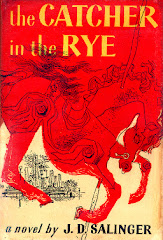
Journal Entries - The Catcher in the Rye

19 September 2007
Entry1
Ch. 1

Through his protagonist, J.D. Salinger vageuly forshadows that his protoagonist may have some serious mental health issues. I am not sure if that is true, but they Chapter 1 has been going it seems to me that he hasn't had the best life, and even though he loved his parents, they were still some what crazy. The protagonist does not seem to like the way his brother 'prostitutes' himself for the acting agencies. I am guessing he feels his brother is selling out and can do much better. He seems to care much for his family. Even though they may have been the cause for his, 'lousy childhood.' I am guessing the lousy childhood his parents have supplied for him makes him not want to grow up or anything, and may/has cause/caused some trauma.

Entry 2
Pg 5

The protagonist seems to be all over the place with the story he seems to be telling. I am guessing his stories are all over the place because his mind seems to be scattered. He cannot seem to keep his thoughts straight nor what he is saying. The way he reminisces seems as if he misses those memories. The protagonist is acting as if he has become something he doesn't like and may be missing those memories and thinking to himself that he should have enjoyed those moments rather than dislike them.


22 September 2007
Entry 3
Ch. 2
Quote: "Game, my ass. Some game. If you get on the side where all the hot-shots are, then it’s a game, alright I’ll admit that. But if you get on the other side, where there aren’t any hot-shots, then what’s a game about it? Nothing. "

Mr. Spencer is telling Holden about Life and it is a game and you must play by the rules. Holden seems to see himself on the side where there aren't any hot-shots. He is identifieng with them and how lonley they are. Holden feels lonely -- alienated even. He feels as if he is the victim to everyone else's happiness. Or that he feels like the so called hot shots are happy and comfortable with themselves and he is not. This makes me pretty sad.


Entry 4
Pg 17

Holden Caufield seems manic-depressive. He seems to be saddened by the most trivial matters. His random thoughts make him seem as if it is hard for him to concentrate. Holden comes off as being dissapointed in people in general. I think Holden has just given up on people which causes him to be depressed. Also he may be avoiding thoughts of his future on purpose because he feels as if he is a disspaointment and may not want to think about him failing in the future. Holden seems to think a lot of adults are 'phony'. Such as his principal and few other parents at his other schools. I am not quite sure but his way of being immature is a way of staying young because he fears growing older and becoming a phony.

24 September 2007
Entry 5
Quote: "All I need is a goddamn audience." Pg. 30

It seems as if Holden does not like to be acknowledged mcuh. He'd perfer to alienate himself from others. I want to say he may be shy, but I really don't think that is the case here. He may just not like to know what others think of him in fear that he might get a bad critique. Holden resents being observed, but has an interest in observing. He seems so wrapped up in critiquing others and pointing out their flaws, I think it is a defense mechanism so he can find an excuse to not open up to anyone that is beneath him because most of the people he encounters he describes them to be not as good or just dumb.

Entry 6
Pg 34

Holden seems to alienate people from himself by pointing out his flaws, this gives him an excuse to not be close with a person. It's different with Stradlater because he describes Stradlater as a pretty decent looking guy, although some how Holden turns it around in making all of that negative. It seems to not get him anywhere in relationships and friendships. He talks about how he has been on these dates but I am guess they don't work out because he doesn't seem to go into depth with them except for saying how he just double dated and seems to end it there.

25 Spetember 2007
Entry 7
Pg. 40

Holden had gotten really ticked about the whole Stradlater thing. There were so many reasons, like he wouldn't tell Holden about Jane or that whole composition thing. Something seemed to have snapped inside of him. I guess you can only push Holden to a certain point before he snaps a little bit. Although I don't think Stradlater pushing him around, or the fact that Stradlater not telling him about Jane was what had ticked him off. It could have probably been the fact that Holden is leaving another school.

Entry 8
Quote:
"It was nice though, when we got out of the dining room. . .it looked pretty as hell and we were throwing snow balls. . ."

The way Holden describes the scenery makes him seem as if he is truly happy. I think this is the only time Holden seems to be truly at peace so far in the book. He has been complaining about a lot of things, and this is a very apparent contrast to all of those complaints. The snowball fight must have made him feel like a true child playing with his friends and being reckless, or something like it. It made him feel young, at that moment he must have felt that he was not going to grow older.

26 September 2007
Entry 9
Quote: "You can always tell a moron, they never want to discuss anything. . ." Pg. 45

Holden knew he was going to get himself hurt by Stradlater but he pushed his buttons anyway. For some odd reason Holden seemed like he wanted to get hurt. Why is it that Holden seems to like to get a rise out of people? Holden talks about himself being a pacifist, but if that were true then why is it that he has the complusion to purposly have people beat him up? Does Holden like this? It is said that girls often mutilate themselves by cutting themselves to stop feeling pain, but boys don't, they find other ways such as purposly getting into fights and having other people hurt them as a way of self-mutilation.

Entry 10
Page 56

Obviously, Holden is a compulsive liar. For some reason telling the truth for him makes him feel awkward and lieing makes him feel right. A compulsive liar lies out of habit due to the enviorment he or she was raised in. So maybe when Holden was younger he had to lie because it was necessary in the enviorment he was living in. Makes me wonder how 'lousy' his childhood really was.

27 September 2007
Entry 11
Pg. 62

I don't understand all these sexual acts or whatever that takes place and Holden happens to describe in deatail. I'm guessing it has to do with the whole 'coming of age' thing. Instead of going in order from being young to getting older, he starts off at being 16 then jumps back and fourth with the time of his life and age. His memories are very random but percise. I am not completely undertanding why he is doing this.

Entry 12
Pg. 66-68

Holden speaks of his sister very fondly. It's obvious he loves her deeply, it's good that he had a healthy relationship with is sister Pheobe. This confuses me about his lousy childhood that he describes earlier. He speaks of his family so fonldy talking about hos Pheobe was so smart, D.B. was a great writer, Allie was a smart guy his parents were caring. Holden might just be a very depressed person if all of that had made him happy but then depressed him at the same time because that's what I am getting out of these passages.

27 September 2007
Entry 13
Pg. 74

Holden seems to be a very peculiar person and likes to play around and lie to others. It is sort of like a nervous tick or something -- his lieing. When he feels uncomfortable he lies. Sometimes he lies to excite himself because he apparaently gets bored with others. He seems to lie to put himself in another reality because the one he is living in doesn't seem to amaze him enough since, according to him, all the people he seems to encounter are 'phonies'. Well mostly the adults anyway.

Entry14
Pg. 77

It is obvious that Holden holds an interst for Jane, and it has been going on for a while, even when he didn't see her or even realize it. Janes seems to be the only person Holden doesn't speak lowly of. This Jane character seems to be the only one that is not related to Holden that happens to hold his interest. I do not understand why though, maybe it's because she cried infront of him and that she showed true emotions, either that or he was the just the first girl he had a crush on and since he could never actually really have her he has still always wanted her. It's like the whole want what you can't have thing.

28 September 2007
Entry 15
Pg. 85-90

Holden Caufeild is an alcoholic. Plain and simple. Throughout these few pages, actually a little more than just these few pages, he has been talking about how depressed he was and he's been drinking alot, and when the bar wouldn't serve him because of his failure to produce an ID then he got a little miffed at the fact that he couldn't drink. So he just kept going bar to bar because he was just so depressed. That's whats wrong with him. He's depressed all the time. Everything makes him sad. It's because he reads way too much into everything and over analyzes it several times. Also I think when he thinks way too far into the future--his future it also depresses him. He is afraid to grow up for some odd reason. Also he is afraid to go home because his parents may think he has failed them. . .again.

Entry 16
98-99

Okay Holden might just live in his own reality to run away from everything that makes him depressed. Mayeb that is why he lies so much, just so he can get away and be someone else, so he doesn't have to face growin gup or anything that makes him feel sad. Wow this boy is really despressing. Holden talks about his brother and pretending that he is still alive and making up for what had gone wrong, not even anything serious it was just a little thing and it meant so much to him, and he talks to his dead brother at night when he feels like he should pray. How insane is that!? His brother Allie seems to be his comfortable place. Not only his brother but his whole family, and if that is so then why is Holden running away from them? He isn't going straight back home, just around it to avoid his family. He speaks so fondly of them, well atleast his brothers and sister, and sometimes his mother but why is he avoiding them all and makign excuses in not seeing them? Is Holden afraid? It seems like he is running away and hiding from something from his past.

1 October 2007
Entry 17
Pg 104

After Holden gets beaten up by Maurice, Holden fantasizes about hurting Maurice -- even killing him in such a dramatic way. Afterwards Holden talks about how he feels like comitting suicide, I wonder if he actually is suicidal. Holden seems very depressed so it was possible for him to commit suicide if he really wanted to. It's interesting how all of his emotional pain doesn't seem to phase him much and want to make him kill himself, but all of this physical pain does.

Entry 18
pg. 106

Holden is one hell of a hypocrite. He talks about all these 'perverts' but he has just as much lust as anyone else he describes ,but what I really wanted to talk about was the suitcase he mentions. I am not sure if it is important or not but he apparantly dislikes people with old poor looking suitcases. But it goes deeper than that obviously, it shows how Holden feels like he couldn't connect with his former roomate because the suitcase was a boundary for both of them. Although his other former roomate Stradlater had a fancy Holden and Holden said that he was more comfortable with him because of it. It shows that Holden would perfer to be with people that he could identifu with somehow.

2 October 2007
Entry 19
Pg. 121

Holden talks about how it is hard for him to like actors because they are so phony. Throughout the whole entire book he sounds like an old grumpy guy. He is around 17 but he sounds like he is much older. . .like 70. Again When he is at the Museum Holden sees and mentions the ducks he has been mentioning for a while now. Holden is very curious about the dissapearance of these ducks in the pond even though he knows that they fly South in the Winter and always come back in the Spring. Honestly, I am tried of hearing about these ducks. Anyway, the way I see it is that the ducks or birds. . .whatever, symbolize innocence. Only because curiousity is often in childeren and Holden holds this deep curiousity for these ducks and curiousity is often inmbeded in childeren whom are often innocent. The curiosity in these ducks. . .or birds brings out Holdens innocence and his childlike mentality.

Entry 20
Pg. 121
Quote: "The best thing though, in that Museum was that everything always stayed right where it was. Nobody'd move."

We've established that Holden isn't very comfortable with change. Holden likes the Museum because unlike reality, it doesn't change. It's the only place that stays the same. He seems dissapointed that people can't be like the Museum -- the same. They are constantly changing and Holden dislikes that. The Museum is the reality Holden wishes he could live in, where everything is unchanging and the same, infinite even. Holden doesn't like that in the real world he doesn't understand why everyone is a phony, but he likes the Museum because everything is understandable and simple. Everything is fixated on being the same and can never change, an that is what Holden wants it's what he is comfortable with.

3 October 2007
Entry 21
Pg. 125
Quote: "I told her I loved her, it was a lie ofcourse, but I meant it when I said it."

Holden is still very sexually awkward. What does that even mean?! I seriously do not understand this quote. What does he mean that it was a lie but he meant it when he said it.
Like he meant it but it was a lie. What?! This is so confusing. Holden is very comfusing, I don't even think he realized that, that made no sense at all whatsoever. Well, atleast afterwards he admitted that he was crazy. I am glad that he admitted he was crazy, because that would probably be the only way to explain that quote.

Entry 22
Pg. 130

I am not sure what Holden is going through right now but he is just letting all of his emotions out and feeling reckless. He is so ready to just marry Sally and not care. He was right about being crazy. He doesn't even really love Sally and he knows it yet he jsut wants to be happy and he thinks this may make him happy. That maybe this is his last chance to stay the same forever. Which is a bunch of bologna.

4 October 2007
Entry 23
Pg. 137

Holden is thinking about his brother Allie again and how Allie had enjoyed the insignificant orchestra player becuase he was the only one who had such pride in what he was doing. Allie's death has really tramatized Holden. I am not sure if Allie had died young, but maybe that's why Holden wants to stay young or is afraid of change and growing up, becuase of his brother's untimely death.

Entry 24
Pg. 144

Holden's sexual awkwardenss is intensified in this chapter. His curiousity of sex and girls is childlike. He keeps asking Luce about all these personal questions about his sex life to try and get a better understanding. It's quite sad. What makes it even more sad though, is the fact that Holden knows he's being too forward and stepping out of line, but his childlike curiousity won't stop him. He is acting very immature and he doesn't care.

5 October 2007
Entry 25
Pg. 150

I feel terrible for Holden. I mean he is only 17 and he is such a drunk. He is so sad all the time and he doesn't even have a plausable reason to be. He just is. Holden had called Sally when he was drunk. Which is odd because I really expected him to call Jane. He seemed to like Jane alot, but for some reason he went all crazy and told Sally to marry him. . . He is one odd kid.

Entry 26
Pg. 157

Holden is finally home. I do not understand his fear of coming home to his parents. Maybe it is because he fears he has failed them again and he may actually have to grow up this time. He loves his younger sister, he loves to spen time with her too. He loves Phoebe, he loves all kids. Only because Holden wishes he were one. He doesn't want to grow up he loves the innocence and curiousity of kids. He believes that kids are truly genuine. He fears becoming older and being a phony, if he were a kid then he wouldn't have to be phony.

6 October 2007
Entry 27
Pg. 168

Holden is back home and he is speaking with his sister Phoebe about why exactly he wasn't kicked out but why he left the school. He even lies to his sister. Holden is just making excuses for why the school wasn't right for him. Nothing ever seems to make him happy. He over exaggerates mostly everything. Especially when he talks about how 'phony' the kids at school are, I mean maybe there's nothing wrong with everyone else, maybe it's just Holden, okay actually it is Holden.

Entry 28
Pg 173
Quote: "You know that scong If a body catch a body coming down the rye. . .what I have to do, I have to catch everybody that's going over the cliff. . ."

Pheobe asks Holden what he wants to do, and he replies by saying he wants to be in a rye and catch all the kids that fall over the cliff. Basically he wants to protect the purity of the young childeren before they hurt themselves. Going over the cliff means growing up and making mistakes and being a 'phony'. Holden doesn't want that for the childeren, Holden knows he's fake, and he doesn't want the kids to turn out like him so he feels he should protect them.

8 October 2007
Entry 29
Pg. 178-79

Pheobe offered to give Holden her Christmas savings so he can get a cab. Holden started to cry and couldn't stop. By now Holden must have been feeling pretty pathetic and depressed. It was just about eight dollars. Still, though, Holden must have felt pretty crappy, and maybe overwhelmed as well. Hadn't seen his sister in thelongest time and when she went and did something as generous as offer him her Christmas savings it broke his heart. In a way Pheobe was helping Holden when all Holden wants to do is help childeren, he wants to be the 'Catcher in the rye.'

Entry 30
Pg. 187
Quote: ' This fall I think you're riding for-it's a special kind of fall, a horrible kind...He just keeps falling and falling.'

According to an ex-teacher of Holden's, Holden is looking for something he won't be able to find because nothing ever seems to make him happy. Holden is just a sad person. He is depressed for no reason.

9 October 2007
Entry 31
Pg. 193
Quote: "When something perverty like that happens, I start sweating like a bastard. That kind of stuffs happend to me about twenty times since I was a kid."

Holden is referring to Mr. Antolini stroking Holden's head while he was asleep. Apparently Holden has been molested or something when he was a child? Maybe that is why he has such a hard time with sex and women and relationships and an awkwardness with them all. Also maybe Holden's wanting to protect childeren make up for the fact that he was never protected as a child? Maybe? Oh I think so.

Thursday, August 16, 2007

English Honors 10 Essay

Moonisah Ali
Mrs. Bosch
English 10 Honors
17 August 2007

People often wonder why they are who they are. There are many effects in a human’s life that shape their personality to make them who they are in the future. It takes time for a human to develop and seep into the final stages of their persona. Usually it is family history or the memory of it that shapes one for their future. People must go through pain and devastation to learn from their mistakes and become wiser as they grow into adult hood. From time to time it does take one life changing event to force one to put there lives into perspective. Knowing the intimate details of a human being’s family or cultural detail can move one to reach out to one’s loved ones with empathy. When one can be able to reflect on the patterns of one’s choices and manners they may happen to be unaware of the impact of their ancestral history has on them. Many traditions shape and develop a person by expanding their knowledge of their past and their ancestor’s past. Also new relationships and broken ones can be learned from and grow a person’s emotional maturity. Though a person’s desire to grow coerce them into looking to the future, one can learn so much by peering into the past.

As I develop into young adulthood, I have succumbed to the realization that due to my past experiences and family traditions I am who I am, or am becoming. I have often questioned my reasons for my thoughts, actions, motives and etc. Never in my life would I have thought that I like who I am becoming because of the mistakes I have made or because of my parents actions. They teach me so much day by day by not even doing much. Just because they are my parents they have the most largest effect on my life. Their judgment seems to matter the most. Given that they have more control over my own life than I do. I have found out that my mind is existing because of the trial and error I have gone through in my life, the traditions my family has followed for years and possibly the people I have met and known such as family members and friends, are what have shaped me and continue to shape me.

Error indeed, is a horrific word, but through error is the only way a person can grow and learn from their mistakes. Through out my years I have made many drastic errors that have forced me to question whether I regretted the error of my ways or not. I can honestly say no, because error has taught me many lessons. How to not commit that same mistake again. Making mistakes has also made me wiser. Many of my mistakes were the cause of me not paying attention or not bothering to ask questions. Often I would get very angry at myself for committing any inaccuracies, but as I grew older I understood that by doing wrong I knew what right was. As time progressed I learned how to control my emotions and how to think before I speak, also how to articulate my words so that people would not confuse the meanings of my explanations. I knew how to not do the wrong again, or else it would be very foolish of me. A person’s fault teaches them what not to do.

My family has many traditions which I follow, or used to follow that have reared me towards thinking reasonably and unreasonably. From my family’s heritage, they come off as very conservative and respectful, not only with their actions but also with their minds. My parents’ thinking is often very narrow-minded. Obviously, they think this way because of the way they were raised by their parents. They often want me to think the way they do because they think they have come out very intelligent and successful. My parents do no understand that the times have changed and it is no longer the way it used to be, I have learned from them and have become more of a liberal thinker. Their narrow minded thinking and actions have forced me to want to be different. Not a thing like they were or are. I am thankful that they have tried their best to watch out for me and my well being, and raise me as what they consider to be right. Do to their ways of thinking I have adapted my own ways of thinking as well, they can only teach me so much. After a while a person must take over and think for themselves. People must realize that they won’t always have a sense of a guiding light to lead them through the right path. Such as parents or friends. I have learned this by understanding what my parents want for me, and then figuring out what I want for myself. Knowing that I differ from my parents and that I am not as conservative and have a more free mind, I choose different career paths than they do for me. My parents influence me to be a different person than they had in their minds. They influence me to be not a thing like them.

Language is apart of my heritage that happens to bring the people closer to each other and develop a correlation with each and everyone. People often feel closer and connected with people who seem to speak the same tongue as they do. I adopted the Hindi language from my parents who happened to speak it often around the house. I often speak in Hindi to elders, as a sign of respect. People often enjoy speaking their native language because in a sense it is as if they are preserving their culture. A piece that still lingers on with them whether they move to a new country or continent. Their language is something they can take with them wherever they go. Language is very important in a culture because it forms a sort of connection towards a person’s family. When people have language in common it often makes them feel more secure with the person they are with, when I speak with people in my language, I often feel more closer to them and feel a certain connection and trust with them. With language and speaking to other people, people pften have an understanding towards each other when they speak.

Believe it or not, but everyone you meet has influence you in one way or another. Whether it’s the lunch lady at a school, or a stranger you bumped into, or even your brother. As I develop I have realized that everyone I have ever met or spoken to, or even heard about had influenced my life in the smallest to the largest ways. The music I listen to has liberated my mind into thinking about religion, freedom, diversity and so on. The people I am friends with have taught me how to be more comfortable in my skin. That I do not have to fake my true personality to impress anyone. My friends have made me less self conscious of myself and more easy going and confident of who I am and where I come from and where my family comes from. Even a short conversation with someone I didn’t even know had influence me. We had spoken about the world around us and what it would be like to die. It had made me appreciate life a whole lot more than I ever had before. People often think it is insane that little things can change your like drastically but the often can and have a quick way of doing so. Deep and meaningful friendships can also change a person’s life. They often shape a person to become more mature and more comfortable with themselves and who they are. When those relationships end, people learn how to grow from them and receive closure. Whether it is a life threatening situation or a simple little chat with a stranger either one can change a life dramatically. Also it is easy to learn from others when they make their own mistakes. As people grow they often see others making foolish choices, and by seeing how foolish a person’s choice is they know to choose wiser.

As I progress in my life, I can truly say that I am glad my trials have taught me so many lessons I can take and teach in the future. Being younger I never understood why I acted the way I do with certain people, situations and so one. I became more understanding as to why my parents wanted me to be the way they wanted me to be. Through their pressuring me to mold into who they wanted they made me see what I did not want to be like and how I did want to be. As I grew, I comprehended that it was because of the people I met. They have shaped me to become who I am by the conversations and other interactions I have with them. I have learned to be more open to my heritage by speaking the native tongue. The importance of my native tongue happens to be severely imperative to my connection with my family and my own ethnic background. Everyday people you meet or talk to can also influence you very much. I know that everyone I have met and spoken to has one way or another influenced my life whether it was through a simple conversation or a deep and meaningful friendship.

Monday, July 30, 2007

Essay 1- Things Fall Apart

Moonisah Ali
Mrs. Bosch
English 10 Honors
11 August 2007


Things Fall Apart
Pride is a feeling of self-respect and satisfaction one takes in with their personal achievements or other’s achievements. Human beings take much pride in the person they have realized they have become by the effects of their past, the people they convene, the rivalries they encounter, and traditions they believe in. Pride in a person takes effect once they are pleased with their surroundings and how they over came what ever fear that has challenged them. Whether it is the history of one’s family or their heritage, people try their hardest to follow tradition and still become the epitome of what they consider to be worthy. People often find themselves worthy by following tradition or honoring their heritage. By following a heritage, one is following a tradition that has been passed on from generations and they must some how maintain that tradition. People often have unstable role models to guide them through the journey of life, but once they comprehend what they think is correct they often stray away from the terrible values and develop their own so they can expand in their own way.

In the novel, Things Fall Apart, by Chinua Achebe, Achebe depicts his pride in family, heritage, memory, language and lives through his main character Okonkwo. Living in Nigeria, Okonkwo’s life is based on a constant domination of fear and anger. He feared turning into what he loathed -- his father. Achebe shows that in Okonkwo’s memory of his father, he [Okonkwo] had remembered him as an unsuccessful man, according to what his heritage’s expectations were. Achebe also showed how the Igbo community had communicated with each other through language and proverbs. He [Achebe] illustrates the importance of family and heritage and how they construct each and every human being into who they become in life. Chinua Achebe exemplifies his pride in family, heritage, memory, language through his characters and their behaviors.

Achebe had written Things Fall Apart to show the importance of language in the African culture. Achebe tosses many Igbo words around to show that they are much too intricate for direct translation into English. In the novel, Mr. Brown’s translator's translation is laughed at by the Igbo people because his conversion of the language is a bit different from their [Igbo’s] own. The language itself is very unique and cannot be translated by the smartest men. The Igbo people laughing showed their interpretation of the translator to be unintelligent. The Igbo language had many songs, “Eze elin, elina! Sala Eze ilikwa ya Ikwaba akwa oligboli ebe danda nechi eze ebe uzuz nete egwu Sala” (60). Some songs were sang for protection and some for celebration. Achebe used a lot more than just songs in Igbo language, he used proverbs and folktales as well. Language was a way for everyone to communicate with one another and demonstrate that they understood one another. To the Igbo people language was a way to know who their people were and it was a sense of acceptance towards one another. By translating the songs, folktales and proverbs he had masterfully incarcerated the beauty in the language and the pride he took in using it [language] in the book.

In Things Fall Apart, Chinua Achebe shows his pride in memory by showing how Okonkwo remembers his father’s unproductive life so vividly that he knows he does not want to turn out that way, ‘He was poor and his wife and children had barely enough to eat. People laughed at him because he was a loafer, and they swore never to lend him any more money. . .” (5). This is how Unoka, Oknonkwo’s father, was perceived. Okonkwo had wanted no part of being a failure as his father was. Unoka had no remorse in the way he treated others and his family. He would leave his wife and children starving and ask to borrow from others and not pay them back. Unoka was lazy, poor, wasteful and cowardly. With the money he had borrowed he would never help feed his family, he would just waste the money on trivial objects such as potent beverages for himself. “ If any money came his way, and it seldom did, he immediately bought gourds of palm-wine, called about his neighbors and made merry” (4). Unoka was a very reckless man. Okonkwo had many aspirations that distracted him from following the same path as his father, “His life had been ruled by a great passion -- to become one of the lords of the clan” (131). Okonkwo consciously adopted differing traits from his father so he could make his life better in a world that valued masculinity. Achebe made it seem that in remembering the past one could learn from their mistakes and others and create a more meaningful future for themselves.

Heritage has a way of building one’s character. Achebe had shown this by how Okonkwo had developed in the novel. It [heritage] had built Okonkwo into a strong man that had no limits in his success, “His fame rested on solid personal achievements” (3). Through the many traditions Okonkwo’s heritage had to offer, Okonkwo had followed them and shaped himself to be adored by the community. Achebe depicted that by following one’s heritage and traditions one was able to win the praise of others in the community. Without the arts of heritage and traditions people would have a lack of a society. Okonkwo’s heritage seemed to have, what the Igbo people considered, moral values. Okonkwo’s heritage was a way of communicating with others and being proud of what had formed him and continued to form him to the person he was going to be. Achebe took much appreciation in heritage by showing how Okonkwo was forced out of his fatherland and into his motherland and was given a lesson on appreciating where one originates from. Uchenda, Okonkwo’s father-in-law, questioned Okonkwo about his presence at is motherland, when Okonkwo did not answer, Uchenda told him about how, “Your mother is there to protect you” (134). Achebe wanted to show how family relations and heritage connected towards one another. One was to be well equipped in knowing their background and where they originated from, which was their mother and father.

Family seemed to be very important to Achebe. Okonkwo had committed accidental manslaughter and was sent to live with is mother’s family. The time Okonkwo had gotten there he seemed a bit estranged from his mother‘s family, but Uchenda made sure he felt like home and understood that, “. . .there is no one from whom it is well” (135). Uchenda tried explaining to Okonkwo that he should not weep for himself and think that he is the only one that has gone through a horrible ordeal. He wanted him to know that everyone has their own pain they must go through everyday. Uchenda wanted Okonkwo to be open with his emotions and not feel as if he has suffered greatly because there are many that have suffered more. Uchenda wanted Okonkwo that he should not refuse to be comforted by his mother’s kinsmen when he was in a dismal state. Uchenda and the rest of the family had received Okonkwo affectionately by trying their best to show him they were there for him and his family and that Okonkwo did not need to prove himself in being strong to his mother’s kin because they excepted him either way. The importance of family showed in many ways, “Okonkwo and his family worked very hard to plant a new farm” (131). This exemplified how after Okonkwo’s exile his family was there for him to help build a new life.

Achebe had a way of showing the importance of life in Things Fall Apart, towards the ending of the novel the protagonist, Okonkwo had killed himself. The cause of this unfortunate event was because Okonkwo had felt abandoned by his fellow men. Okonkwo feared that without revolting there would be no way to stop the white men taking over, so his anger towards his leader for not want to go to war had gotten the best of Okonkwo and he acted upon the anger. Okonkwo had a plan to over throw the white men and their leaders. Okonkwo, expecting his fellow men to join him in revolt, ends up killing his own leader with a machete. Okonkwo had been infuriated that his leader’s wishes were not to fight back with the white men. Okonkwo felt that, “Worthy men were no more” (200). He felt that without fighting back and winning men had given up. That men were no longer strong and were weak to have given into the white man’s persuasion. Achebe had valued life very much, and by ending Okonkwo’s he showed how much more important life was. Also, how people make hasty decisions and do not understand how by making one incorrect decision they can affect others. By Okonkwo killing himself he had drawn an even bigger wedge within the white men and the Igbo people. Although the Iboe people had still respected him for his achievements and courage. “That man was one of the greatest men in Umofia. You drove him to kill himself. And now he will be buried like a dog” (208). The Igbo people put the blame on the white men for the cause of Okonkwo’s death. The Igbo people had strongly valued a life of one of their people, especially with the amount of accomplishments one had.

Chinua Achebe had strong feelings about the importance of family, heritage, language, memory and lives. His pride in each subject had shown throughout his novel and characters. Achebe’s way of depicting his pride was very admirable. The Igbo language was a way of communication, the heritage showed how one was shape into a person, memory was a way for a person to learn from prior mistakes and having a family showed how much of a support system they could be in helping one find their way back to a steady life. Also through tradition Achebe showed how a person would grow and learn from the ancestors and their ways. Achebe’ had his protagonist, Okonkwo, go through life by being dominated by his own fear and rage. Okonwko killed himself in the ending and the Igbo people were very devastated, which showed how important Okonkwo and his life was.